Article: Delusion and the Divided Mind
How hemisphere imbalance affects attention, metacognition, and SCRUM Agile
📘 Summary: Delusion, the Divided Mind, and the Attention Cycle
This article introduces Ian McGilchrist’s key ideas on the divided brain and how Left vs Right hemisphere dominance creates different cognitive failures (delusion vs overwhelm).
It explains the ideal Right → Left → Right cycle and shows why proper balance is essential for metacognition and effective SCRUM Agile practices.
Key references:
- The Matter with Things by Ian McGilchrist (2021)
- The Master and His Emissary by Ian McGilchrist (2009)
- Thinking, Fast and Slow by Daniel Kahneman
- Attention and metacognition research in Agile contexts
1 The Divided Mind: Left vs Right Hemisphere
The brain is not symmetric. The left hemisphere excels at narrow focus, abstraction, categorization, and manipulation. The right hemisphere excels at broad attention, context, flow, and holistic understanding.
When one side dominates, different failures appear:
- Left domination → Delusion (rigid false certainty, denial of reality, mechanistic thinking)
- Right domination → Overwhelm (diffuse flooding, loss of structure, paralysis)
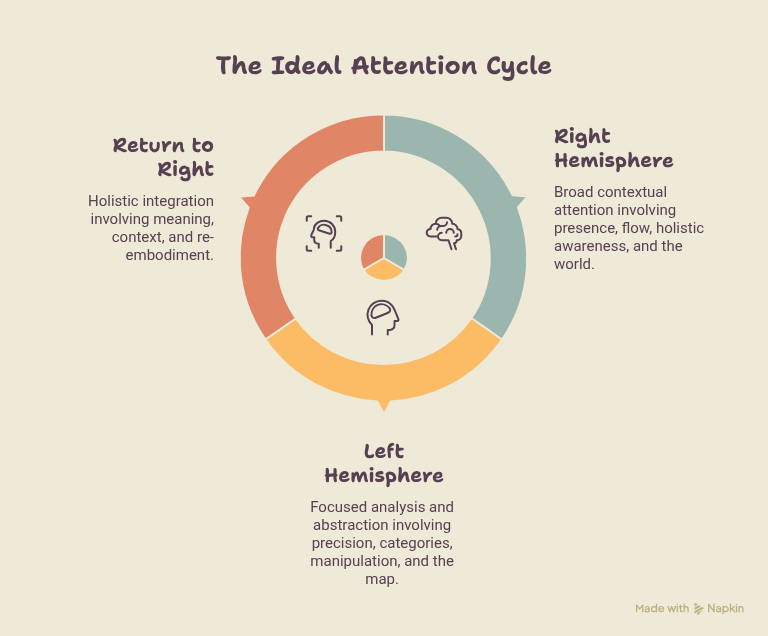
Healthy cognition requires the full Right → Left → Right cycle.
In Ian McGilchrist’s The Matter with Things: Our Brains, Our Delusions, and the Unmaking of the World (2021), “delusion” refers to a profound distortion in judgment and perception of reality, arising primarily when the brain’s left hemisphere dominates without sufficient input or correction from the right hemisphere.
McGilchrist, a psychiatrist and philosopher, builds on his earlier work The Master and His Emissary by arguing that the two cerebral hemispheres attend to the world differently.
- The right hemisphere provides a broad, contextual, holistic, and embodied apprehension of reality — seeing interconnected wholes, flow, uniqueness, ambiguity, and lived presence (“com-prehension”).
- The left hemisphere, by contrast, narrows focus for manipulation and utility: it abstracts, categorizes, re-presents (makes a simplified “map” or model), seeks certainty, and breaks things into parts (“ap-prehension”).
Both are essential, but the left should serve the right.
Delusion emerges when this balance fails — especially with right-hemisphere impairment or cultural over-reliance on left-hemisphere modes.
The left hemisphere, unchecked, becomes “frankly delusional.” It confabulates (makes up plausible but false explanations), denies deficits (e.g., anosognosia, where patients insist a paralyzed limb works), misidentifies people or objects (e.g., Capgras syndrome: believing loved ones are impostors; Fregoli syndrome: mistaking strangers for familiar people), and generates bizarre beliefs like somatoparaphrenia (denying a limb belongs to oneself) or Cotard’s syndrome (believing one is dead).
These syndromes are far more common with right-hemisphere damage, revealing the left’s tendencies: overconfidence, rigidity, literalism, loss of context and flow, and indifference to inconsistency.
The left constructs a coherent but impoverished “re-presentation” of the world — mechanistic, fragmented, and self-validating — detached from the richer, more veridical reality the right hemisphere perceives.
McGilchrist extends this clinically observed pattern culturally: Western modernity’s emphasis on abstraction, mechanism, bureaucracy, and certainty mirrors a collective left-hemisphere takeover, leading to societal “delusions” — a loss of depth, value, purpose, and sacredness, resulting in the “unmaking of the world.”
In essence, delusion is not mere falsehood but a failure of judgment: mistaking the map for the territory, certainty for truth, and manipulation for understanding.
True judgment integrates both hemispheres (ideally right → left → right), grounding abstraction in embodied experience. Without the right’s anchoring, we live in simulacra, blind to reality’s complexity.
Right → Left → Right: The Ideal Attention Cycle:
- Right hemisphere – Opens with broad, contextual attention (presence of the world).
- Left hemisphere – Narrows for focused analysis, abstraction, and precision.
- Return to Right – Integrates the details back into the bigger living picture.
Failure occurs when the cycle is broken — especially when the left does not return control to the right.
2 Dominations
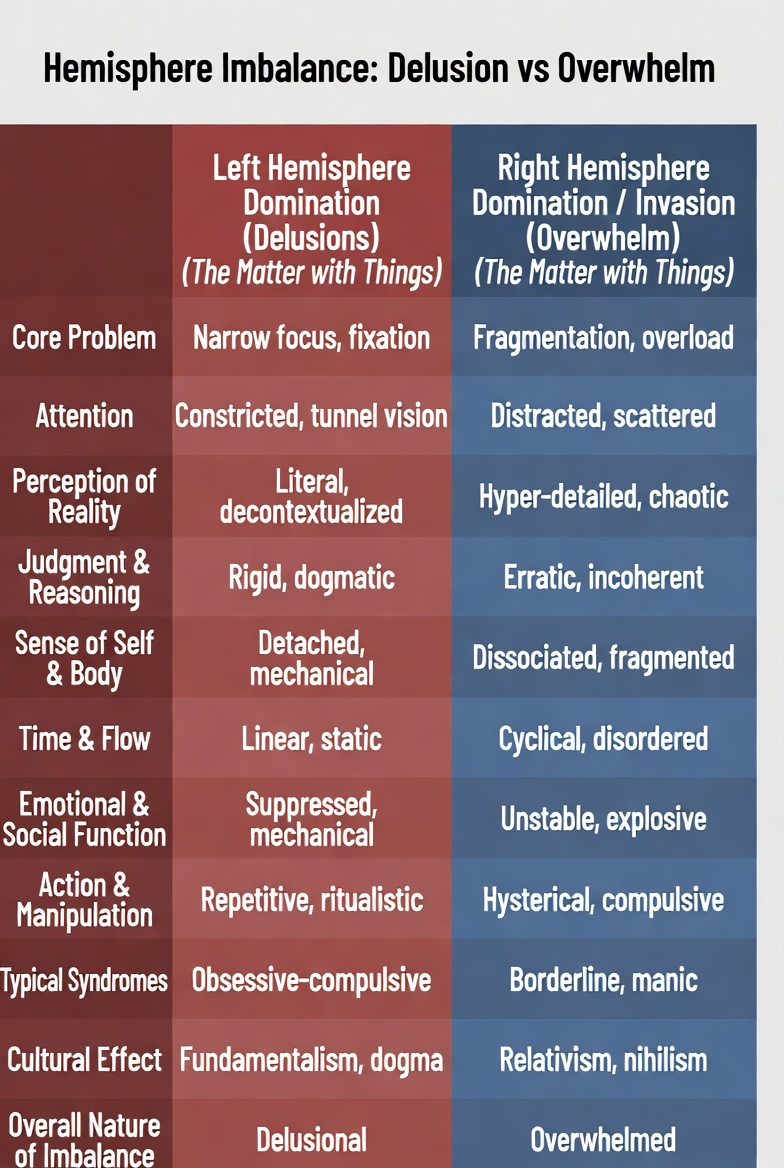
Left Hemisphere Domination: The Delusional Mode
Main failure: The left creates a simplified, coherent but false map and mistakes it for reality.
Characteristics:
- Overconfidence and rigidity
- Denial of deficits or contradictions
- Mechanistic, decontextualized thinking
- Loss of flow, meaning, and the “big picture”
In SCRUM: Teams become obsessed with processes, metrics, and documentation while losing sight of customer value and adaptability.
Right Hemisphere Domination: The Overwhelm Mode
Main failure: Too much context and flow with insufficient structure.
Characteristics:
- Emotional or informational flooding
- Difficulty making decisions or prioritizing
- Loss of boundaries and practical action
In SCRUM: Teams may feel overwhelmed by complexity, struggle with focus during sprints, or avoid necessary structure.
3 Metacognition as Supervisor of the Cycle
Metacognition is the ability to monitor and adjust your own thinking — the “coach” that notices when the cycle is broken.
Key metacognitive questions:
- Am I stuck in narrow left-mode (delusion)?
- Am I flooded by right-mode (overwhelm)?
- Have I returned to the right for integration?
- Is my current attention style serving the intention?
In SCRUM: Retrospectives are formal metacognition. Daily stand-ups and sprint reviews should also include cycle awareness.
4 Practical Implications for SCRUM Agile Teams
- Intention (Product/Sprint Goal) → Sets the Right-hemisphere direction.
- Salience → Right hemisphere helps detect what truly matters.
- Focused Attention → Left hemisphere does the detailed work.
- Metacognition (Retro) → Ensures return to the Right for holistic learning.
Common Agile anti-patterns explained by hemisphere imbalance:
- Analysis paralysis → Excessive left-mode without right integration.
- Scope creep / loss of focus → Weak intention + right overwhelm.
- Zombie sprints → Left domination without living purpose.
Summary Table: Hemisphere Imbalances
| Aspect | Left Domination (Delusion) | Right Domination (Overwhelm) |
|---|---|---|
| Core Failure | Rigid false certainty | Diffuse flooding and paralysis |
| Attention | Narrow, fragmented | Overly broad, scattered |
| Judgment | Overconfident, categorical | Indecisive, context-heavy |
| SCRUM Impact | Process obsession, loss of value | Lack of structure, poor execution |
| Metacognitive Fix | “Zoom out and integrate” | “Add structure and prioritize” |
True agility requires cognitive agility — the disciplined use of the full Right-Left-Right cycle under metacognitive supervision.
5 When and how to shift
When and how to shift between right and left hemisphere modes (and successfully returning to right) is the core skill of good metacognition in McGilchrist’s framework.
Mastering the Right → Left → Right attention cycle is essential for cognitive agility in Scrum.
Moment-to-moment, it prevents left-hemisphere delusion (rigid focus, loss of context) and right-hemisphere overwhelm (diffuse thinking, paralysis).
Throughout the day, intentional shifts sustain energy: broad right-mode for intention and creativity, focused left-mode for execution, and return to right for integration and learning.
In a sprint, this flow powers planning (right vision → left tasks), daily execution (focused work), and retrospectives (holistic reflection).
Without conscious shifting, teams fall into inefficiency, blind spots, or burnout. Proper mode-shifting, guided by metacognition, delivers sharper decisions, better adaptation, and sustainable high performance.
5.1 Learn to Recognize the Two Modes
| Sign | Right Mode (Broad, Holistic) | Left Mode (Narrow, Focused) |
|---|---|---|
| Feel of Attention | Open, spacious, flowing, contextual | Tight, sharp, sequential, detail-oriented |
| Thinking Style | Patterns, intuition, “big picture”, ambiguity | Analysis, categories, logic, precision |
| Body Sensation | Relaxed alertness, whole-body awareness | Tension in head/eyes, “zooming in” |
| Time Experience | Fluid, continuous | Discrete steps, clock-time |
| Emotion | Subtle, rich, connected | More detached or irritable |
| Language | Metaphors, stories, “feels like…” | Definitions, lists, “this means that…” |
When to Shift Right → Left
Go into focused mode
Shift to left when you need:
- Precision, analysis, planning, or execution
- Breaking a problem into parts
- Writing code, making decisions with clear criteria, organizing tasks
Triggers to shift:
- You have a clear intention and need to act on it.
- You notice vagueness or drifting (“I’m thinking in circles”).
- You need to solve a specific, well-defined problem.
How to shift:
- Narrow your visual/mental focus (literally look at one thing).
- Use lists, diagrams, or step-by-step plans.
- Verbalize internally: “Now I’m analyzing this part.”
When to Shift Left → Right
Return to the whole
This is the most important and most neglected step.
Shift back to right when:
- You’ve done enough focused work and need integration.
- You feel stuck, rigid, or losing perspective.
- You need creativity, insight, or to check “Does this still make sense in the bigger picture?”
- You notice overconfidence, irritation, or “I must be right.”
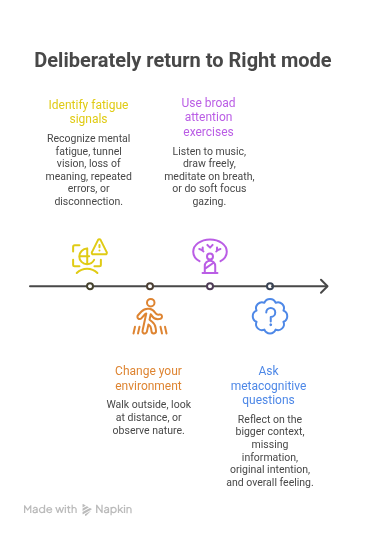
Practical signals it’s time to return:
- Mental fatigue or tunnel vision.
- Loss of meaning or motivation.
- Repeated small errors or diminishing returns.
- Feeling disconnected from purpose or people.
How to deliberately return to Right mode:
- Change your environment (walk outside, look at distance, nature).
- Use broad attention exercises: listen to music, draw freely, meditate on breath, or do “soft focus” gazing.
- Ask metacognitive questions:
- “What’s the bigger context here?”
- “Am I missing something important?”
- “Does this still serve the original intention?”
- “How does this feel as a whole?”
5.2 Practice for the Full Cycle
- Start with Right — Begin with intention and broad awareness (e.g., “What’s the real goal of this sprint?”).
- Move to Left — Do focused work (coding, planning, detailing).
- Return to Right — Take a short break for integration (walk, breathe, reflect). Ask: “What did I learn? What’s the bigger picture now?”
- Repeat — Use retrospectives as formal cycle resets.
Quick Metacognitive Checklist (Use during the day)
- Am I in Left mode too long? → Signs: rigidity, irritation, loss of meaning.
- Am I stuck in Right mode? → Signs: vagueness, inability to decide or execute.
- Have I completed the cycle? → Did I return to the right for integration?
In SCRUM terms:
- Sprint Planning → Right (vision) → Left (tasks)
- Daily work → Left focus
- Daily Stand-up + Retro → Return to Right (integration & learning)