Article: Intention – Salience – Attention – Metacognition
About metacognition and its relation to SCRUM Agile
📘 Summary: Intention – Salience – Attention – Metacognition
This article breaks down four key mental processes—Intention, Salience, Attention, and Metacognition—in plain language.
It shows how they work together for sharper thinking and better learning, with direct ties to SCRUM Agile practices like sprints, daily stand-ups, and retrospectives.
Key references:
- Attention is All We Have by David Bessis (explores attention as core to cognition).
- Attention Is All You Need – the seminal Transformer paper (shows attention mechanisms in AI, mirroring human focus).
- Thinking, Fast and Slow by Daniel Kahneman (foundational on attention, System 1/2 thinking, and metacognitive awareness).
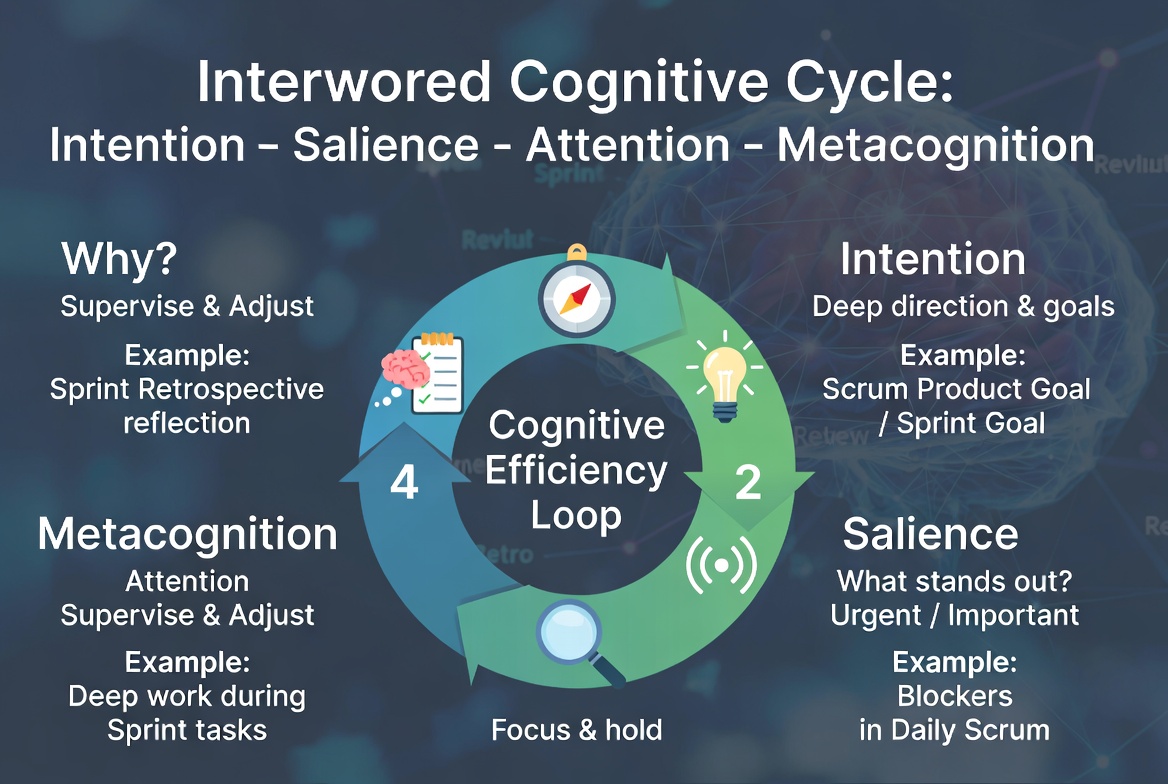
1 Intention: Goal-Setting and Purpose
Intention is your deep why—the guiding direction for your efforts.
It answers: Why am I here? What am I trying to achieve, become, or protect?
Simple example: A Scrum team sets the intention to “deliver a reliable user login feature that improves security and user satisfaction.” This isn’t just a task list; it’s the bigger purpose that keeps everyone aligned.
In SCRUM: The Product Goal or Sprint Goal acts as shared intention. Without it, teams chase shiny objects and lose focus.
2 Salience: What Stands Out Right Now, interrupting focus
Salience is what grabs your mind—what feels important, urgent, or relevant right now.
It answers: What stands out as meaningful, threatening, or attractive in this moment?
Simple example: During a sprint, a sudden production bug becomes highly salient (it “pops” because it risks customer trust). A minor UI tweak feels less salient.
In the brain: The salience network (involving the insula and anterior cingulate) helps detect what deserves attention.
In SCRUM: Daily stand-ups surface salient blockers. Retrospectives highlight what felt important during the sprint. It is highly context-dependent—what’s salient today may be irrelevant tomorrow, so the signal/noise ratio is crucial and the impediment detection process is key.
3 Attention: Active Focus and Mental Energy
Attention is actively pointing and holding your focus.
It answers: Where is my mind pointed right now? What am I keeping in the foreground?
Simple example: A developer focuses deeply on writing clean code for the login endpoint (narrow attention). Later, they broaden attention to review how it fits the whole system.
In SCRUM: Time-boxed tasks and focused pairing sessions sustain attention. The “Attention is All You Need” idea applies here—effective focus drives progress.
4 Metacognition: Thinking About Your Own Thinking
Metacognition is thinking about your own thinking—the supervisor or “coach” in your head.
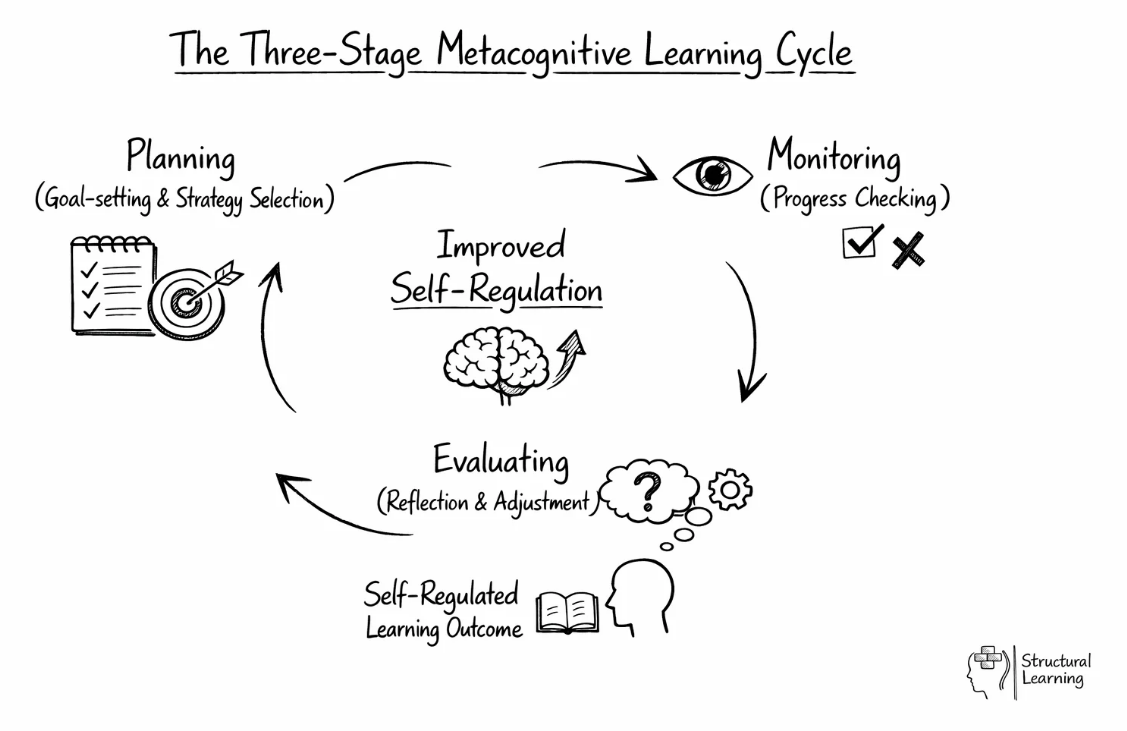
It answers: Is my current focus valid, useful, and free of bias or distortion? Do I need to adjust?
Simple example: Midway through coding, you notice, “I’m over-focusing on perfecting this one function while ignoring integration tests. That’s a bias toward details—time to zoom out.”
Key book: Know Thyself by Stephen M. Fleming or Kahneman’s Thinking, Fast and Slow for practical metacognition.
In SCRUM: Retrospectives are pure metacognition—“What worked? What didn’t? How can we improve our process?”
5 How They Work Together: Interwoven for Cognitive Efficiency
These four aren’t separate steps—they form a dynamic loop that maximizes cognitive efficiency (getting the most value from limited mental energy).
The cycle in simple terms:
- Intention sets the overall direction (the destination).
- Salience flags what matters most in the current environment (the signals).
- Attention locks onto those signals and holds them (the work).
- Metacognition constantly checks: “Is this the best use of my attention? Am I biased, tired, or off-track?” Then it loops back to adjust intention, re-prioritize salience, or shift attention.
Cognitive efficiency payoff:
- You avoid wasting energy on low-value distractions.
- You switch modes wisely (deep focus vs. big-picture scan).
- You catch errors early (bias, fatigue, wrong assumptions).
- You learn faster because reflection turns experience into improvement.
Concrete everyday example:
- Intention: Build a great product sprint.
- Salience: Bug reports and customer feedback rise up.
- Attention: Team focuses on fixing the bug in the stand-up and tasking.
- Metacognition (in retro): “We spent too much time on this bug because we ignored early tests. Next sprint, let’s adjust our Definition of Done.”
This loop prevents “analysis paralysis” (too much narrow attention) or “scatter” (no intention). Research links agile practices like Scrum to improved metacognitive abilities through structured planning, reflection, and adaptation.
6 Questions
Attention Questions (What to ask while focusing):
- What exactly am I looking at?
- Where am I in the problem?
- How deep/narrow or broad should my focus be?
- How long should I stay here before switching?
- Is this the right mode (creative, analytical, collaborative)?
Metacognitive Questions (The supervisor check):
- Is this the right target for my intention?
- Am I missing key information?
- Is my current style (precise left-style or holistic right-style) helping or trapping me?
- Am I biased by fear, ego, or tiredness?
- Do I need to rest, pivot, or get input?
7 Relation to Left/Right Thinking Styles
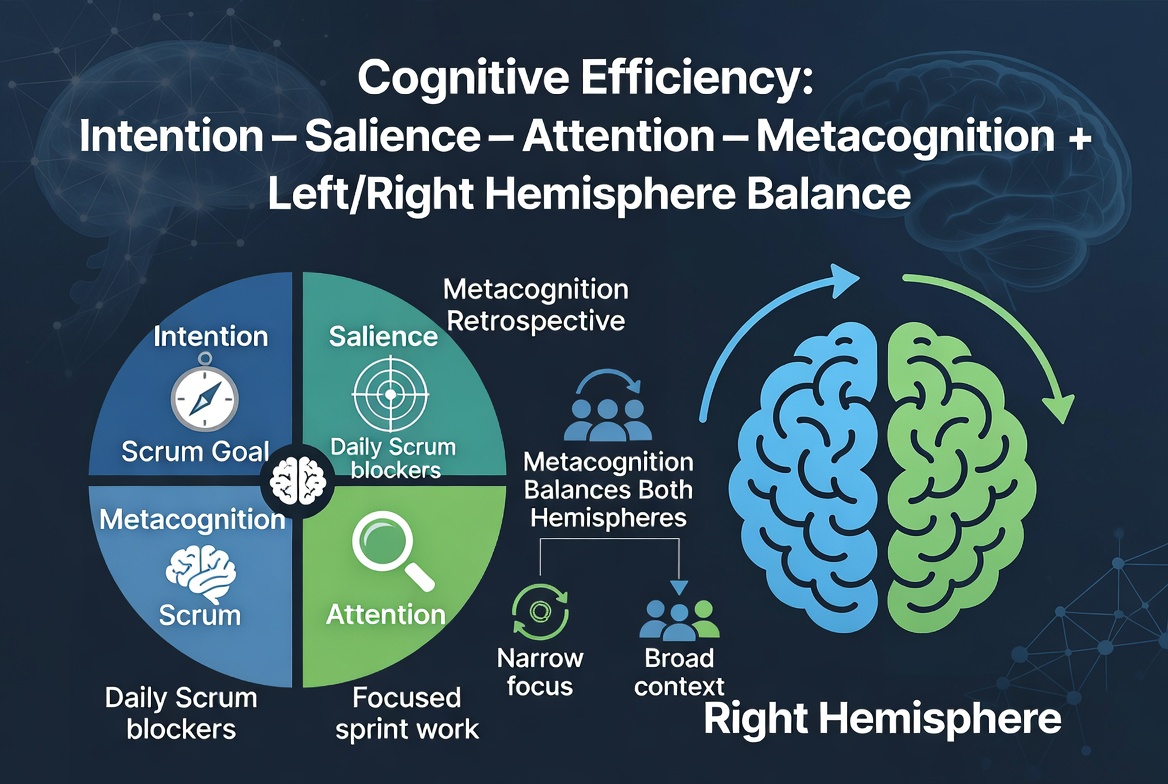
- Left-style (precision, categories, control): Great for detailed tasks.
- Right-style (context, patterns, ambiguity): Great for big-picture and creativity.
Metacognition supervises the balance:
- “You’re narrowing too much—broaden for context.”
- “You’re too vague—add structure.”
- “You’re forcing a quick close—gather more info.”
- “You’re stuck in details—zoom out.”
In SCRUM: Cross-functional teams and retros naturally blend both styles under metacognitive oversight.
8 Summary
- Intention: Your why and direction.
- Salience: What grabs focus now.
- Attention: What you actively hold.
- Metacognition: The smart supervisor that keeps everything efficient and on-track.
Together, they create a high-efficiency cognitive engine. In SCRUM Agile, this engine powers sprints, daily inspections, and continuous adaptation—turning good teams into great ones.
Further reading:
- Thinking, Fast and Slow – Daniel Kahneman.
- Studies on agile and metacognition (e.g., nursing education research showing Scrum boosts planning and self-awareness).
- Brain networks: Salience network research for deeper science.