SCRUM
Agile Manifesto Three Pillars of Empiricism
- Transparency: Significant aspects of the process must be visible to those responsible for the outcome.
- Transparency requires that those aspects be defined by a common standard so observers share a common understanding of what is being seen.
- Inspection: Scrum users must frequently inspect Scrum artifacts and progress toward a Sprint Goal to detect undesirable variances. Their inspection should not be so frequent that it gets in the way of the work, and should be performed by skilled inspectors at the point of work.
- Adaptation: If an inspector determines that one or more aspects of a process deviate outside acceptable limits, and that the resulting product will be unacceptable, the process or the material being processed must be adjusted.
- An adjustment must be made as soon as possible to minimize further deviation.
Agile Manifesto Four Foundations
Through this work we have come to value:
- Individuals and interactions over processes and tools
- Working software over comprehensive documentation
- Customer collaboration over contract negotiation
- Responding to change over following a plan
That is, while there is value in the items on the right, we value the items on the left more.
Summary
Scrum is a lightweight framework based on empiricism and lean thinking, designed to deliver value through iterative, incremental work on complex problems. It relies on transparency, inspection, and adaptation to continuously improve outcomes.
A Scrum Team is a small, cross-functional, self-managing unit composed of a Product Owner, Scrum Master, and Developers.
- The Product Owner maximizes value and manages the Product Backlog, an ordered list of work aligned to the Product Goal.
- Developers create usable Increments each Sprint, following a shared Definition of Done.
- The Scrum Master ensures effective Scrum adoption, removes impediments, and fosters continuous improvement.
Work happens in Sprints (≤1 month), which produce a potentially releasable Increment. Each Sprint includes four key events:
- Sprint Planning (define Sprint Goal and select work),
- Daily Scrum (inspect progress and adapt plan),
- Sprint Review (inspect Increment with stakeholders),
- and Sprint Retrospective (improve process and quality).
Artifacts provide transparency:
- Product Backlog (what),
- Sprint Backlog (plan),
- and Increment (value delivered),
- each tied to commitments:
- Product Goal,
- Sprint Goal,
- and Definition of Done.
Scrum enforces focus, commitment, openness, respect, and courage. It is intentionally minimal, enabling teams to adapt practices while maintaining structure, accountability, and continuous value delivery.
Agile Manifesto 12 Principles
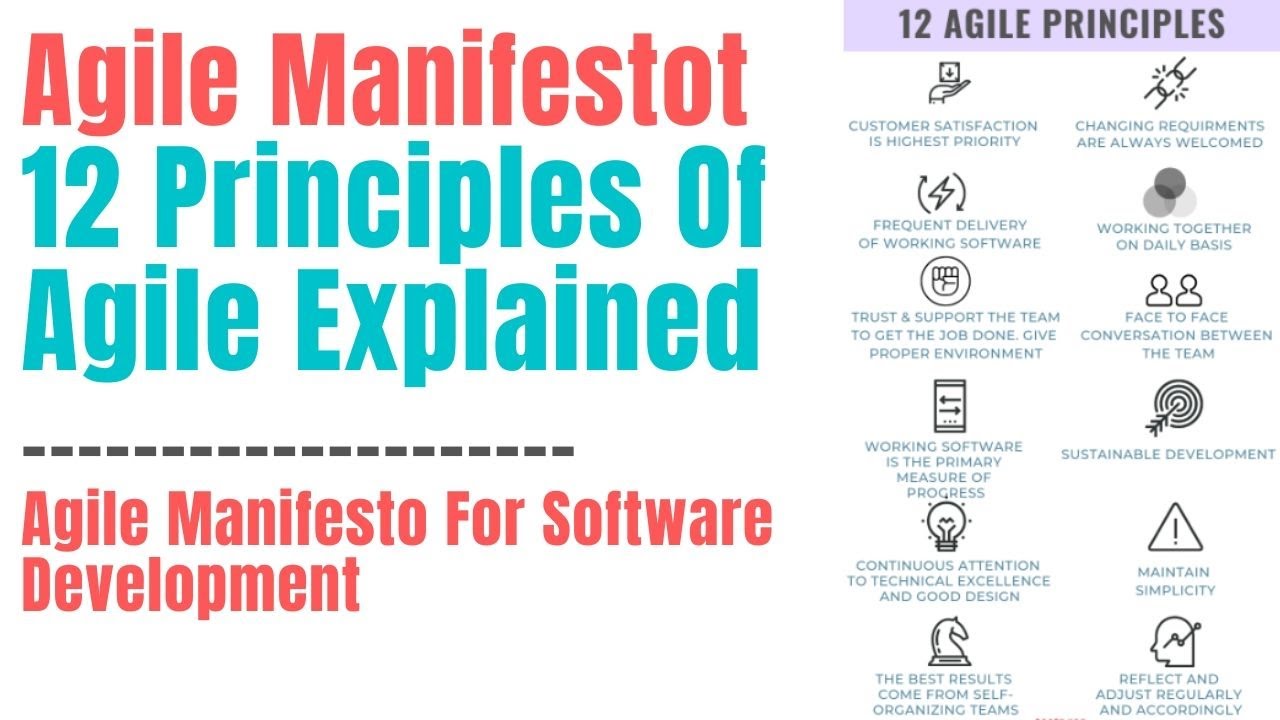
- Our highest priority is to satisfy the customer through early and continuous delivery of valuable software.
- Welcome changing requirements, even late in development. Agile processes harness change for the customer’s competitive advantage.
- Deliver working software frequently, from a couple of weeks to a couple of months, with a preference to the shorter timescale.
- Business people and developers must work together daily throughout the project.
- Build projects around motivated individuals. Give them the environment and support they need, and trust them to get the job done.
- The most efficient and effective method of conveying information to and within a development team is face-to-face conversation.
- Working software is the primary measure of progress.
- Agile processes promote sustainable development. The sponsors, developers, and users should be able to maintain a constant pace indefinitely.
- Continuous attention to technical excellence and good design enhances agility.
- Simplicity–the art of maximizing the amount of work not done–is essential.
- The best architectures, requirements, and designs emerge from self-organizing teams.
- At regular intervals, the team reflects on how to become more effective, then tunes and adjusts its behavior accordingly.
Top-50 keywords in SCRUM
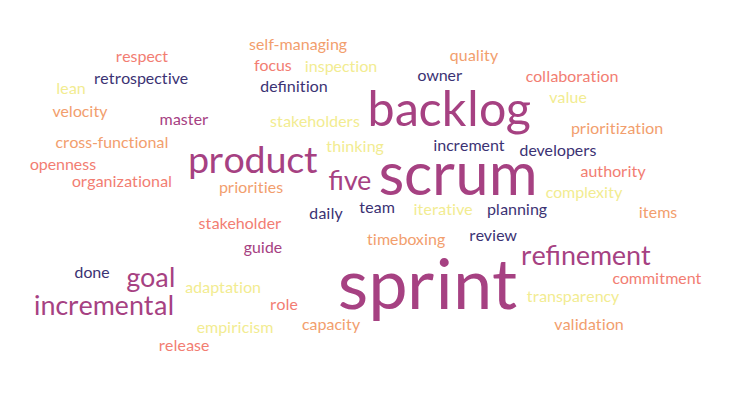
Scrum - Scrum Guide - Scrum Master - Product Owner - Developers - Scrum Team - Product Backlog - Sprint Backlog - Increment - Definition of Done - Product Goal - Sprint Goal - Sprint - Sprint Planning - Daily Scrum - Sprint Review - Sprint Retrospective - Transparency - Inspection - Adaptation - Empiricism - Lean thinking - Value - Complexity - Stakeholders - Incremental - Iterative - Cross-functional - Self-managing - Timeboxing - Velocity - Capacity - Backlog refinement - Refinement - Prioritization - Priorities - Backlog items - Quality - Validation - Release - Stakeholder collaboration - Organizational role - Authority - Commitment - Focus - Openness - Respect - Courage - Continuous improvement - Empirical process - Cadence - Burndown - Burnup - Forecasting - Predictability - Risk management - Incremental delivery - The three artifacts - The five events - The four pillars - The five values